Saturday, February 14, 2015

Romanesque Period


What is Romanesque Architecture?

Romanesque is an architectural style that dominated in Western Europe in the 11th and 12th centuries, and whose name means “from Rome.” This was a term coined in the 19th century, reflecting that fact that Romanesque buildings, like those of the ancient Roman Empire, tend to display a strong sense of proportion and order, are solid and robust, and feature numerous rounded arches and vaults (a key difference from Greek architecture, which does not use arches and vaults).
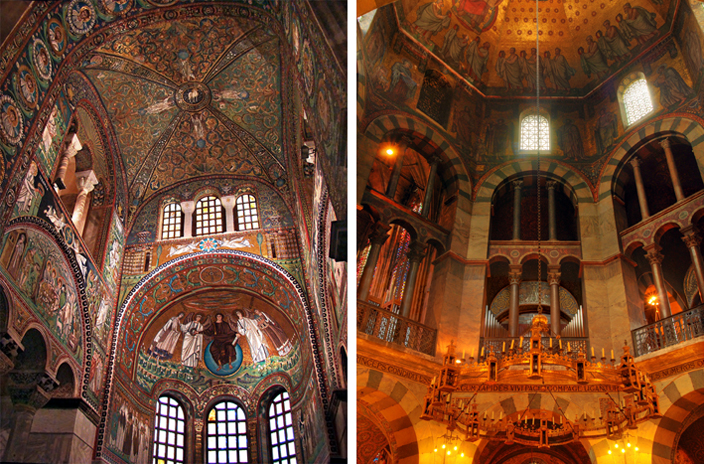


The sixth-century church of St Vitale in Ravenna, Italy (left), had a major influence on the court buildings of one of the greatest European emperors: Charlemagne. In turn, Charlemagne's palace complex, (right) constructed around 800, influenced the architecture of much of western Europe, leading to the development of the Romanesque style.


Sources of Influence

Despite its name, the inspiration behind Romanesque architecture was not Rome, but the architecture of the Byzantine Empire. The church of St Vitale in Ravenna, Italy, dating from the 6th century, was one building that had a major influence: it inspired the palace complex of the emperor Charlemagne in Aachen, Germany, built around 800 AD.

Charlemagne was a key figure of the middle ages, the first ruler to reunite Western Europe since the Roman Empire, and a shaper of European identity. Charlemagne's court at Aachen was legendary: it had a major influence on the culture — including the architecture — of much of western Europe. Romanesque architecture developed from the buildings constructed during Charlemagne's reign.


The Context in which the Romanesque Developed

Romanesque architecture developed at a time of increasing religious fervour and a rise in the tradition of pilgrimages to the shrines of important saints. To accommodate these pilgrims, churches became larger, and tended to be cross-like in shape. This shape had the advantage of allowing more people to view sacred relics put on display in the centre of the two arms of the cross.
Key Features of Romanesque Architecture

The interiors of Romanesque churches were usually covered with brightly-coloured sculptures, carvings, and paintings, depicting scenes from the Bible. Much of the population of Europe at the time was illiterate, and images were therefore a very useful way of conveying a religious message.

The move from wooden to stone buildings was also a characteristic of the period in which Romanesque architecture developed.

Building large churches in stone meant that the walls had to be extremely thick, and windows quite small (to prevent the building collapsing). With time and practise, less bulky construction techniques became possible. These, first seen in key Romanesque buildings such as Durham Cathedral, were refined with time, leading to the style that followed on from Romanesque: Gothic (13th-15th centuries).
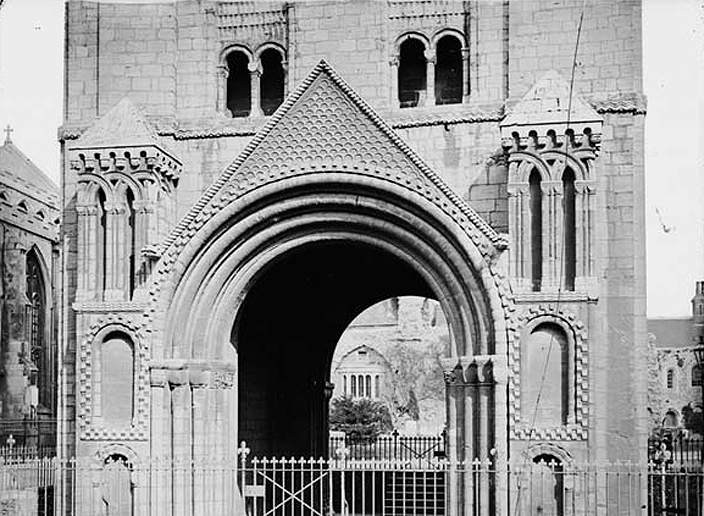


A 12th century Norman tower in Bury St Edmonds, Suffolk, England, showing many of the typical features of Romanesque architecture: namely solid, massive construction with small round-arched windows. The interlocking arches and the carved geometric patterns were very popular forms of architectural ornamentation.


The Semicircular Arch

The semicircular arch was very popular in the Roman Empire. This similarity is likely where the term 'Romanesque' originated. The semicircular arch is strong and durable. Romanesque architects love this arch, and they use it everywhere: doors, windows, ceilings, arcades.
Vaulting


Three types of vaulting popular in Romanesque architecture

Romanesque architects were nothing if not ambitious. Not only did they want to build huge new churches, but they also wanted to roof those churches with masonry, not wood. Now, you can't just run masonry horizontally; you can't build a ceiling like you would a wall. The pieces would fall out.

To tackle this problem, Romanesque architects turned to their favorite form: the semicircular arch. An arch allows you to build unsupported openings out of masonry. It only took a little bit of cleverness to stretch this arch out, making a sort of tunnel. When this arched tunnel is used to roof a building, it's called vaulting. There were three sorts of vaulting popular in Romanesque times. First was the barrel vault. Next came the groin vault, which was later improved to ribbed vault.


Modern Examples


Romanesque Architecture: Characteristics, Examples & History

Sunday, February 8, 2015

 
Peer Reviews


Jalee did a great job with the Early Christian and Byzantine posts. The video she posted from History.com about the Byzantine empire and its fall was a good choice. The pictures and examples she gave for both periods were also well chosen.
 
Alecia wrote a good summary about the Early Christian period. She posted interesting pictures of modern applications for the Byzantine period. I think both posts on these two periods were informative and well done.


Saturday, February 7, 2015

Saint Mark's Basilica, Venice, begun 1063


LaunchPad: Making Ancient and Byzantine Mosaics


The Byzantine Empire

Time period: 330 - 1453 A.D.

Historical Background

Constantine established Constantinople as Rome’s capital, so the fall of Rome to the Goths did not end the empire, it merely relocated its center. Byzantine culture was a continuation of classical Greece and Rome but was distinctive in the way that it synthesized those influences with European and Islamic ones.

Byzantine history spans the period from the late Roman Empire to the beginning of the modern age. Constantine the Great, first Christian ruler of the Roman Empire, moved his capital to Byzantion in 330, renaming the city Constantinople. The state he ruled was Byzant, but the citizens called themselves Romans.

The Byzantine Empire was heir to the Roman Empire. With the passage of time Byzantine civilization became distinct, as Greek influence increased and it dealt with the cultural impacts of Europe, Asia, and, after the seventh century, Islam.

During the Middle Ages, when the concept of Europe developed, Byzantium was in decline and isolated from the West. Thus Europe came into being without Byzantium, the successor to the Roman Empire. By the time Europe was a full-blown concept, Byzantium was no longer a remnant of the Roman Empire, and Constantinople was part of the Ottoman Empir
e.


Architecture

The Golden Age of Byzantine Architecture was under the rule of Justian in 527-565.  It was during this period that the most famous examples of all Byzantine Architecture was built, the Hagia Sophia.  The Hagia Sophia was rebuilt from 532 to 537 after the previous church was destroyed by riots .  This church has some unique features which became the patterns for Byzantine Architecture for years after.  
    The style of the Hagia Sophia or Church of Divine Wisdom, was to have a large dome in the middle of the structure.   The dome has a unique form in that it rest on 4 massive pillars which are arranged in a square.    The dome remained the main focus of the Byzantine Church for the remainder of the empire.  The Eastern Orthodox preferred  a low light, somber, and almost mysterious mood in their services.  The clergy worked often behind the scenes with brief appearances.  They did not embrace the loud organs and congregational  worship which is seen in the western Catholic Church.  So the Hagia Sophia became the model for the Byzantine church because was an architectural style that fit with the type of worship the Orthodox church wanted to emphasize. 
 
Art
 
The style that characterized Byzantine art was almost entirely concerned with religious expression; specifically with the translation of church theology into artistic terms. Byzantine architecture and painting (little sculpture was produced during the Byzantine era) remained uniform and anonymous and developed within a rigid tradition. The result was a sophistication of style rarely equaled in Western art.
Byzantine visual art began with mosaics decorating the walls and domes of churches, as well fresco wall-paintings. So beautiful was the effect of these mosaics that the form was taken up in Italy, especially in Rome and Ravenna. A less public art form in Constantinople, was the icon (from the Greek word 'eikon' meaning 'image') - the holy image panel-paintings which were developed in the monasteries of the eastern church, using encaustic wax paint on portable wooden panels. The greatest collection of this type of early biblical art is in the monastery of St Catherine in Sinai, founded in the 6th century by the Emperor Justinian.


Saint Mark’s Basilica is a cathedral located on St. Mark’s Square in the city of Venice, Italy. It is one of the attractive cathedrals in the city and it is famous for its uniqueness in terms of the design and the magnificent interior as well as being an example of the Byzantine architecture. Many years ago, however, it did not serve as a cathedral. In fact, it was a chapel for the Venetian City and its rulers. Since the 11th century onwards, the cathedral was known by the nickname “Church of Gold,” or “Chiesad’Oro” in Italian.


St. Mark's Basilica - Venice


Modern Examples